Why Traffic Keeps Dropping: Marketing KPI Design in the AI Era

- Why is it getting harder to grow website traffic?
- Why can sales remain stable even when traffic goes down?
- Are AI search and zero-click behavior creating invisible attribution?
- How should marketers design KPIs when brand touchpoints happen outside the website?
These questions are becoming more common for teams that manage websites, SEO, paid media, and content marketing.
For a long time, digital marketing was built around a simple flow: attract users from search, social media, ads, or email, bring them to the website, and measure what they do there.
That model is no longer enough. Users can now research products through AI tools, read summaries directly on search result pages, compare options inside social platforms, and visit the official website only at the very end of the journey.
This article offers a framework for thinking about marketing KPIs in that environment. The main idea is simple: when traffic becomes less visible, marketers need to measure exposure, position, business contribution, and expected baseline performance more carefully.
Why Web Traffic Is Becoming Less Reliable
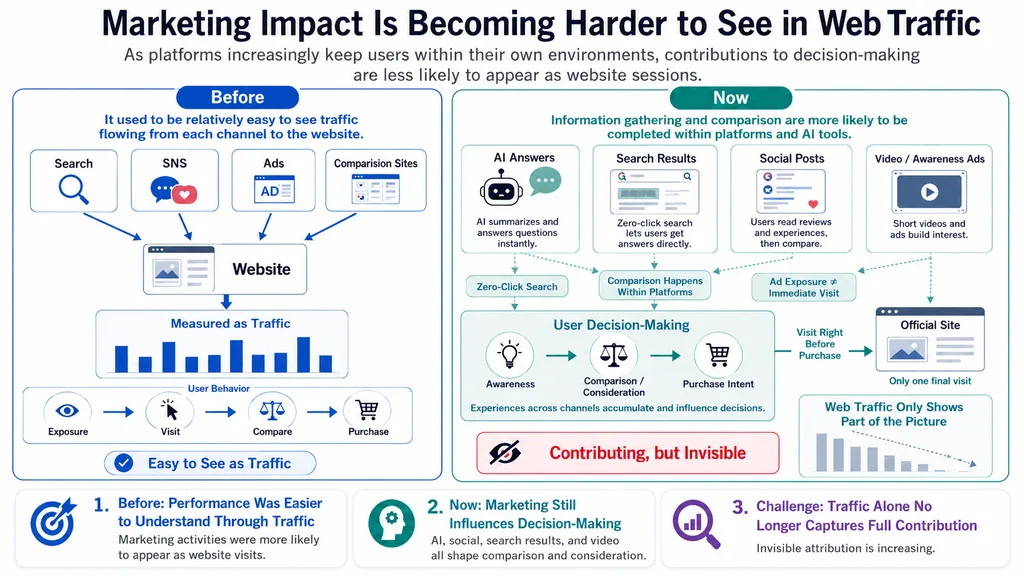
Traditional digital marketing assumed that users would click through to websites during the research phase. That made sessions, users, and clicks useful indicators of demand.
Today, the research phase can happen somewhere else. A user may ask an AI assistant to compare products, read a direct answer on a search results page, or watch reviews inside a platform without clicking an external link.
The brand may still influence the decision, but that influence may not appear as a website session. This is one of the biggest reasons traffic alone is becoming a weaker KPI.
Platforms Are Also Reducing External Clicks
This shift did not start with AI. Search engines, social networks, video platforms, and ad platforms have all been moving toward experiences that keep users inside their own environments.
Search results often provide answers directly. Social platforms may reward native posts more than posts that send users away. Video ads and awareness campaigns can shape demand without producing immediate website visits.
As a result, marketing activity can still be working even when traffic reports do not fully show it.
The Risk of Using Traffic as the Main KPI
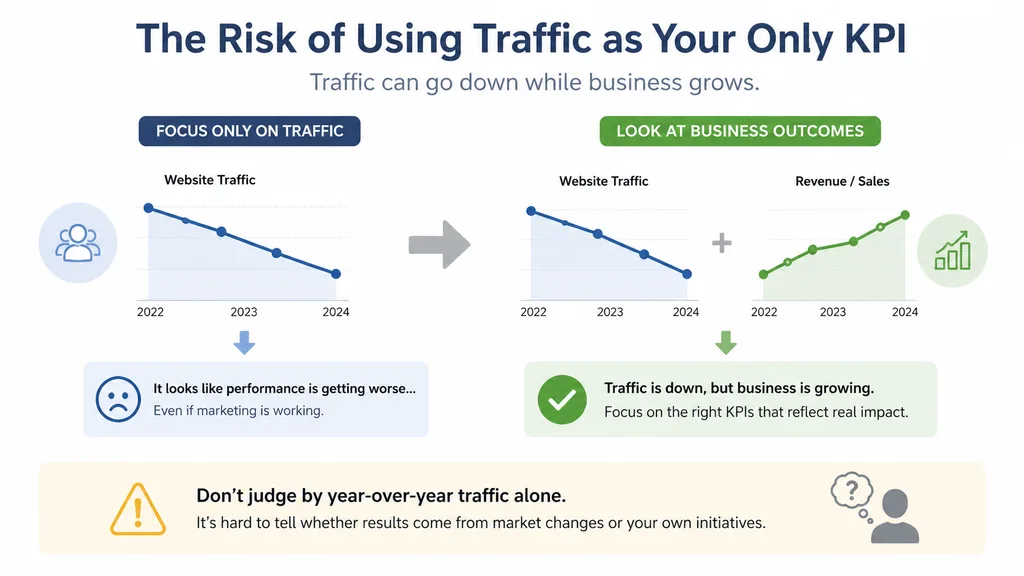
Traffic used to be a practical proxy for growth. More sessions often meant more opportunities, more leads, and more sales.
But in the AI era, traffic can decline while revenue stays flat or even improves. If a team only looks at sessions, it may conclude that marketing is failing even when the underlying business impact is still healthy.
Year-over-year comparisons can also become misleading. A decline may come from structural changes in user behavior, not necessarily from weaker content, worse ads, or poor execution.
Redefining the Role of Marketing

Marketing is not only about bringing people to a website. It is about being present in the right places throughout the customer journey.
That means a brand needs to appear when users discover a category, compare options, evaluate trust, and decide what to buy.
If those steps happen across AI tools, search results, social platforms, communities, marketplaces, and review sites, the KPI system needs to cover those touchpoints too.
New KPI Candidates: Position and Impressions

Clicks depend heavily on user behavior. Impressions, ranking position, share of voice, and visibility are often closer to what marketers can directly improve.
For AI-era KPI design, exposure metrics should become more important:
Channel-Level KPIs to Review
- SEO: rankings, impressions, search appearance, and content coverage
- Paid media: impressions, impression share, reach, and cost per exposure
- Social media: impressions, reach, engagement rate, and branded mentions
- AI search and generative AI: brand mentions, citations, answer position, and source inclusion
These metrics help measure market presence even when fewer users click through to the website.
MMM Becomes More Important for Business Contribution
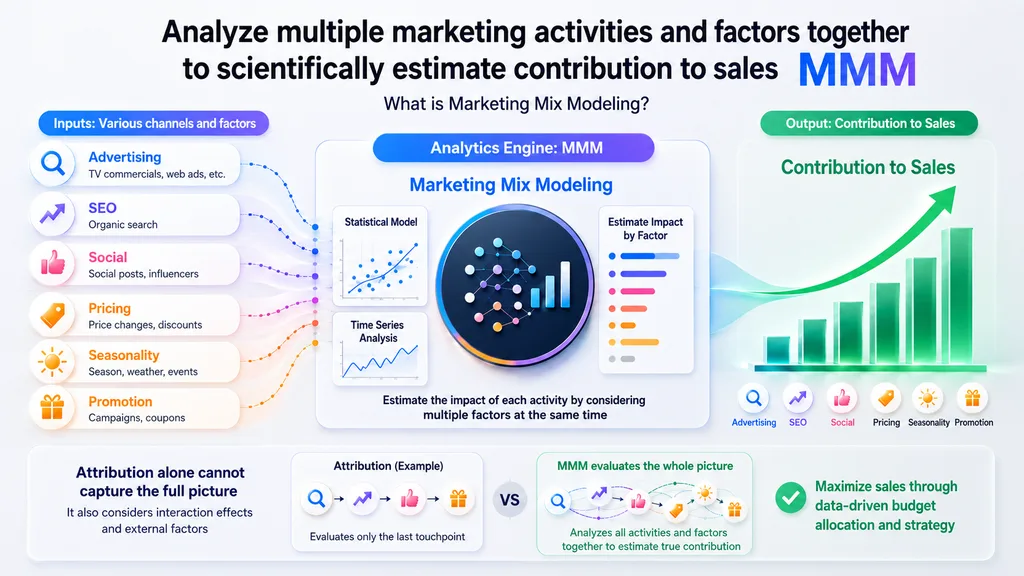
Position and impressions are useful, but business teams still need to understand whether marketing activity contributes to sales.
This is where MMM, or marketing mix modeling, becomes important. MMM uses aggregated data such as media spend, SEO activity, content updates, seasonality, and sales performance to estimate the contribution of different marketing activities.
Unlike user-level attribution, MMM does not require every touchpoint to be tracked perfectly. That makes it useful in a world shaped by privacy restrictions, cookie limitations, AI-assisted research, and missing click paths.
Managing Actions in the AI Era
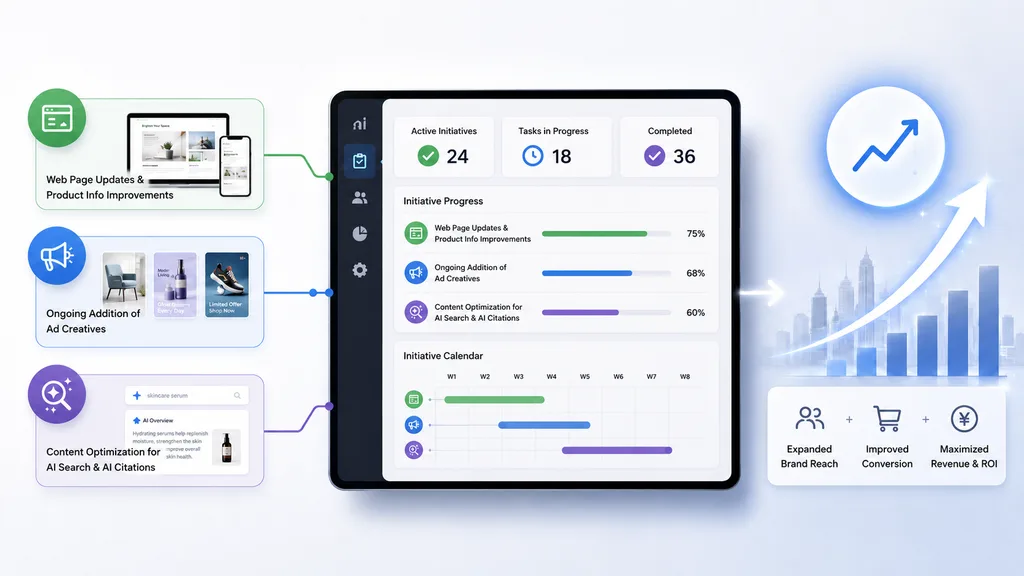
When outcomes become harder to observe directly, it is also useful to manage the actions most likely to influence results.
For example, if analysis shows that certain activities support sales or brand exposure, those activities can become operational KPIs:
- Updating important web pages and product information
- Adding and testing new ad creatives
- Improving content so AI tools and search systems can understand and cite it
- Monitoring branded search, mentions, and category visibility
The point is not to reward activity for its own sake. The point is to identify the actions connected to business value and make sure they are executed consistently.
From Year-over-Year Comparison to Forecast Baselines
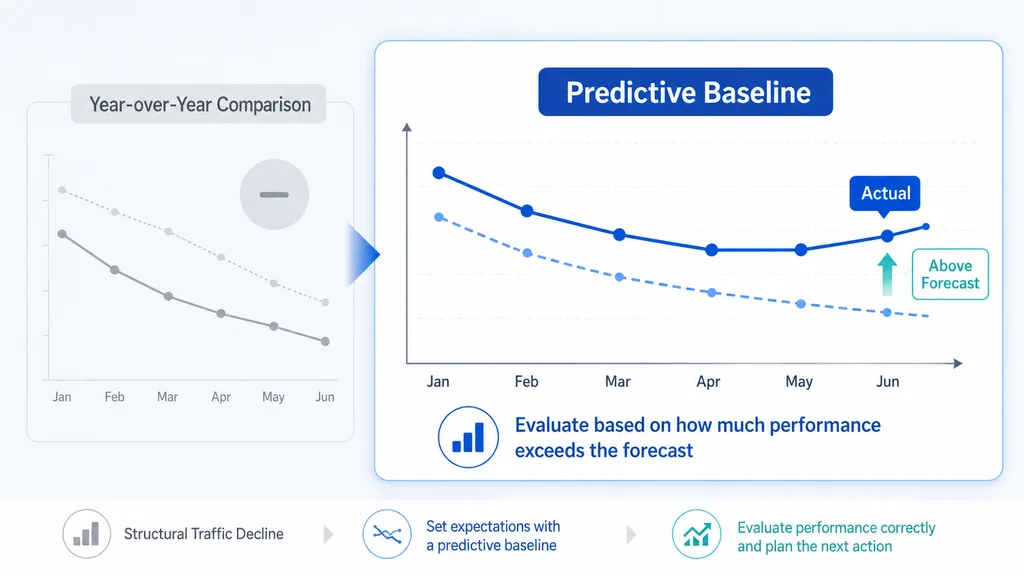
When the market is structurally changing, comparing this year directly with last year can be too simplistic.
A better approach is to create a forecast baseline: an estimate of what would have happened if the team had taken no additional action.
If traffic is down compared with last year but still above the forecast baseline, the marketing program may be performing well. This type of analysis helps separate external market changes from internal execution.
Does This Make Attribution Useless?
No. GA4 data, ad platform conversions, CRM data, and attribution reports are still useful.
The issue is that they should not be the only source of truth. In the AI era, a more realistic KPI system combines attribution data with visibility metrics, MMM, forecast baselines, and operational activity metrics.
Instead of looking for one perfect number, marketers need several angles that together explain what is happening.
Summary
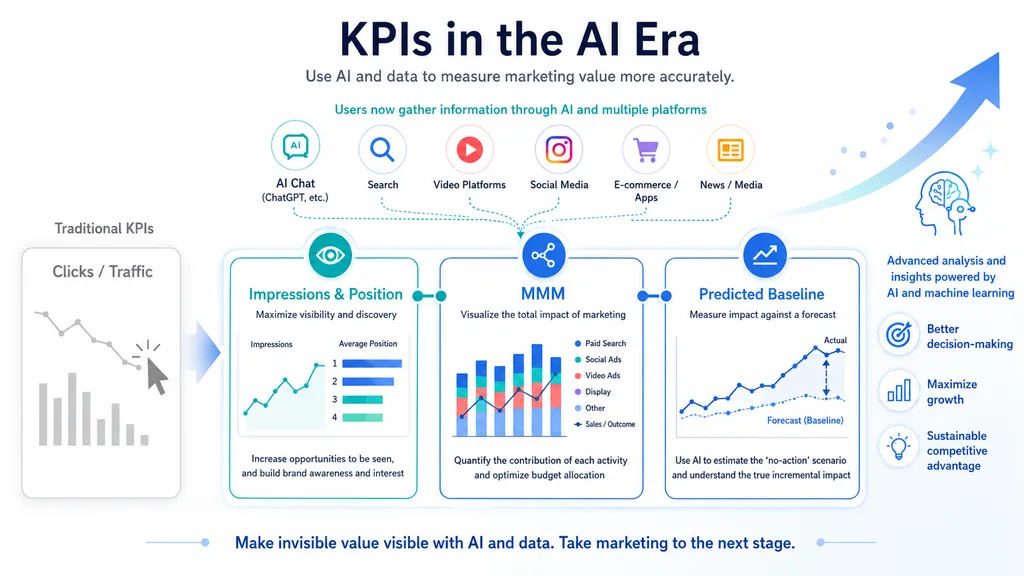
In the AI era, website traffic and clicks are no longer enough to evaluate marketing performance.
Users are researching, comparing, and making decisions across many environments before they ever reach a website. Some of those interactions will not be visible in traditional analytics tools.
Marketing teams should start combining several KPI layers:
- Exposure metrics such as impressions, position, and share of voice
- Business contribution analysis such as MMM
- Forecast baselines instead of simple year-over-year comparisons
- Operational KPIs for actions that influence visibility and sales
This framework can be expanded with more examples and data over time. As a starting point, the key message is clear: marketers need to update KPI design for a world where influence often happens before the click.